
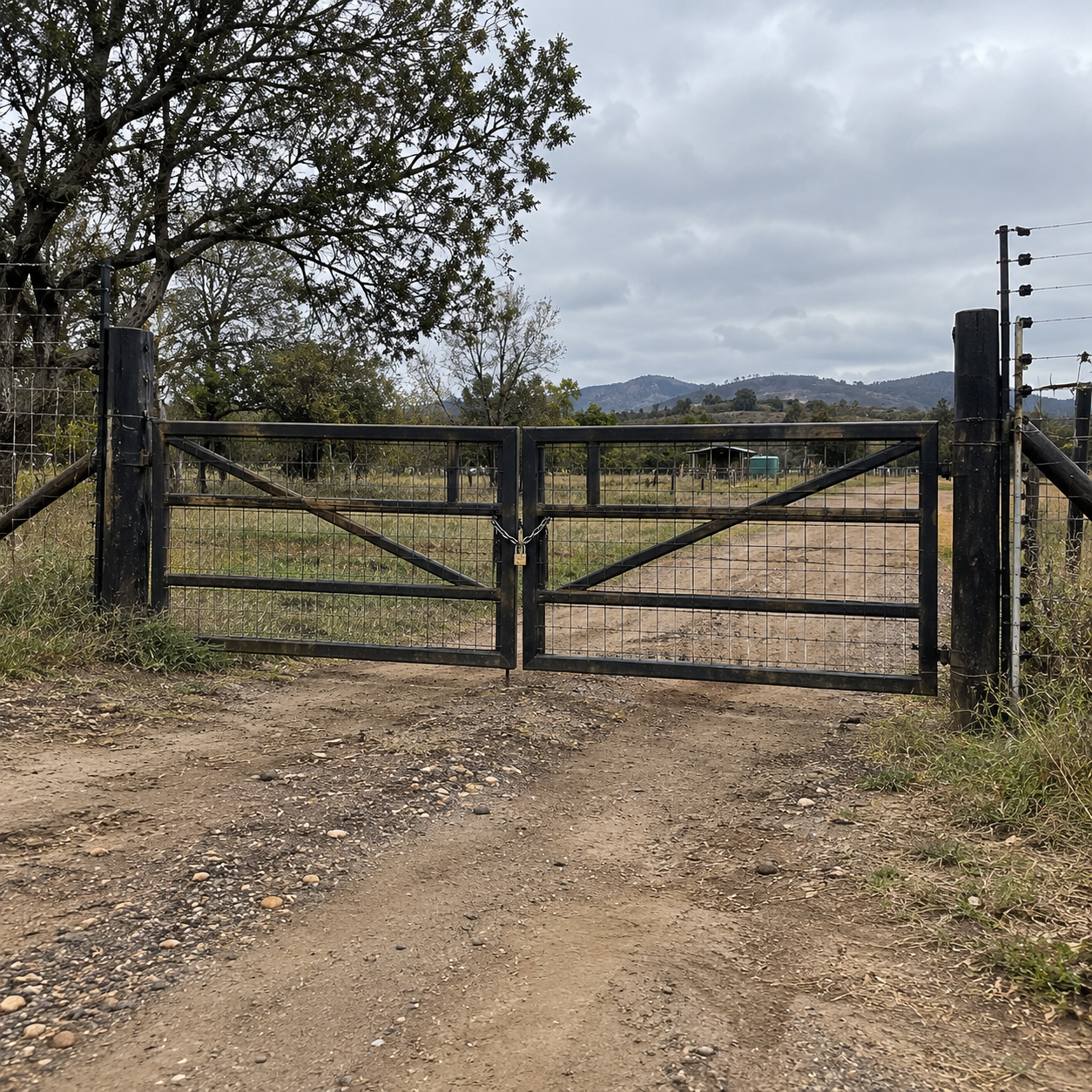
A farm entrance has a difficult job. It needs to allow workers, deliveries, visitors and agricultural vehicles to move through without unnecessary delays, while helping prevent unauthorised access to the property.
Unlike a typical residential driveway, a farm entrance may be used by tractors, livestock vehicles, contractors, delivery trucks and machinery. It may also be situated far from the main house, with limited visibility from occupied buildings. These conditions make entrance security an important part of protecting the wider property.
A heavy gate alone will not solve every security problem. The supporting posts must be secure, the locking mechanism must suit the gate, and the entrance must connect properly with the boundary fence. Where necessary, access control, lighting, cameras and electric fencing can provide additional layers of protection.
The right arrangement depends on the layout of the entrance, the type of vehicles using it, the property’s security risks and how frequently the gate needs to open. A busy agricultural operation has different requirements from a private farm entrance that is used only a few times a day.
Plan a More Secure Farm Entrance
Tell us about your entrance, the type of gate you have and the security improvements you need.
Start by Assessing the Entire Entrance
Before deciding which gate, lock or security system to install, look at the entrance as a whole. This helps identify weaknesses that could undermine even a well-built gate.
Walk around the entrance and examine how the gate meets the boundary fence. Look at the posts, hinges, locking points and ground beneath the gate. Check whether a person could easily climb around the side, lift the gate, reach through the bars or move an adjacent fence panel.
Pay attention to the approach road as well. A gate that is hidden behind thick vegetation or positioned immediately around a blind corner can create visibility problems for both incoming vehicles and people monitoring access. Drivers need enough space to stop and open the gate without leaving a vehicle exposed in an unsafe position.
Consider how the entrance is used throughout a normal working day. If workers regularly leave the gate open while moving equipment, the security arrangement needs to address that behaviour rather than relying entirely on the strength of the gate.
Questions worth asking include:
-
Who needs regular access, and how will authorised people enter?
-
How often do large vehicles or agricultural machinery use the entrance?
-
Can the gate be seen from the farmhouse, office or another occupied building?
-
Are the gate posts and adjoining fence strong enough to resist pressure?
-
Could someone bypass the gate by climbing over, going underneath or cutting through the adjoining fence?
-
Is there reliable electricity for an automated gate, or will the system need backup power?
-
What happens if the gate motor fails or the property experiences a power outage?
These answers help determine whether the entrance needs a stronger physical barrier, better access management, electronic security or a combination of measures.
Choose a Gate That Suits the Farm
Not every gate is suitable for every farm entrance. A gate must be strong enough for its intended use, but it also needs to open reliably, accommodate the vehicles using the entrance and work with the available space.
Sliding gates
A sliding gate moves sideways along a track or a suitable trackless support system. It can be a practical choice where a wide entrance is required but there is limited room for a gate to swing inward or outward.
The main considerations are the gate’s supporting structure, the movement mechanism and the space needed alongside the entrance. A sliding gate can become difficult to operate if its track collects mud, stones or other debris. Its wheels, guides and drive components also need appropriate maintenance.
For automated sliding gates, the motor and drive system must be suitable for the gate’s weight and frequency of use. A gate that is too heavy or poorly aligned can place excessive strain on the motor.
Swing gates
A swing gate opens on hinges, either as a single leaf or as a pair of leaves. This arrangement can work well where there is sufficient clearance for the gate to open without striking vehicles, machinery, uneven ground or other obstacles.
The hinge posts and mounting points need to support the gate’s weight without excessive movement. Heavy gates can place considerable strain on poorly installed posts, particularly when wind or repeated use adds further force.
The opening direction also matters. The gate should not create an unnecessary hazard for vehicles entering or leaving the property, and the layout must allow the gate to move through its full range without obstruction.
Mesh, steel and other gate designs
The gate’s construction should match the level of security required. A well-made steel gate can provide a substantial physical barrier, while a mesh design may be useful where visibility through the entrance is important.
The spacing between bars or mesh openings, the strength of the frame and the quality of the joints all influence how resistant the gate is to climbing, bending or forced entry. Decorative features alone do not establish whether a gate is secure.
The best choice is one that balances strength, visibility, durability, ease of operation and the practical demands of the property.
Make Sure the Gate Posts and Hinges Are Strong Enough
A strong gate can still be vulnerable if the posts supporting it are poorly installed. The posts transfer the gate’s weight and the forces created when it opens, closes or experiences pressure. If they shift, lean or loosen over time, the gate may become difficult to close or leave gaps that compromise security.
Post selection and installation should account for the gate’s size, weight, soil conditions and the forces it will experience. A wide entrance carrying a heavy steel gate may need a more substantial support structure than a small pedestrian gate.
The condition of existing posts is just as important as the original installation. Look for leaning posts, cracked concrete around their bases, loose brackets, rust damage or movement when the gate operates. These signs may indicate that the support structure needs attention.
Hinges also deserve careful consideration. They should be suitable for the gate’s weight and designed to support repeated use. Where appropriate, security-focused hinge designs can reduce the risk of the gate being lifted off its supports. However, the correct arrangement depends on the gate design and the hardware being used.
For a farm entrance that opens frequently, ordinary light-duty hinges may wear out faster than expected. The same applies to brackets, welds and mounting points that are not designed for the forces involved.
If a gate has started sagging or dragging across the ground, do not assume that adjusting the motor will solve the problem. The cause may be a weakened post, worn hinge or distorted frame. Correcting the underlying mechanical issue is essential before the gate can operate reliably again.
Install a Locking Mechanism That Suits the Gate
The locking mechanism is one of the most important parts of entrance security. A gate may be made from heavy steel, but if its locking point is weak, poorly positioned or difficult to secure consistently, the overall entrance can remain vulnerable.
The appropriate lock depends on whether the gate is manual or automated, how often it is used and who needs access.
Manual gate locks
A manual gate needs a locking arrangement that can be secured properly whenever the entrance is not in use. The lock, latch and receiving point should be compatible with the gate’s construction and resistant to ordinary weather exposure.
Check that the gate closes fully and that the locking point aligns correctly. If the gate must be lifted, pushed hard or held in a particular position before the lock engages, the alignment may need attention.
Where a padlock is used, the hasp and surrounding metalwork matter just as much as the padlock itself. A strong lock attached to weak or poorly secured hardware may offer less protection than expected.
The locking arrangement should also be convenient enough for authorised users to operate consistently. If workers struggle with the lock every time a vehicle enters, they may be tempted to leave the gate unsecured.
Automated gate locking
An automated gate uses a motor to control movement, but the motor should not automatically be treated as a complete security lock. The level of resistance to forced opening depends on the motor, gearbox, drive arrangement and any additional locking hardware.
Some systems provide sufficient holding resistance for their intended use, while others may benefit from a compatible supplementary locking mechanism. The correct solution depends on the equipment and the manufacturer’s requirements.
A suitable installation should prevent the gate from being casually pushed or pulled open while avoiding unnecessary strain on the motor. An incompatible external lock can create problems if the motor attempts to move the gate while the lock is engaged.
The locking system should therefore be designed as part of the complete gate installation, not added without considering how the motor operates.
Connect the Gate Securely to the Boundary Fence
One of the easiest weaknesses to overlook is the area immediately beside the gate. The entrance may look secure from the road, yet a person could potentially bypass it by climbing through a gap, moving a loose fence panel or passing underneath the gate.
The boundary fence and gate should function as one continuous barrier. This means checking the connection points on both sides of the entrance and making sure there are no obvious gaps that undermine the gate.
Pay particular attention to the following areas:
-
Gaps beside the gate: The distance between the gate and the posts should be appropriate for its design and allow safe movement without creating an unnecessary opening.
-
Space underneath the gate: The clearance should accommodate the ground conditions and normal operation without leaving a gap that makes bypassing the barrier easy.
-
Fence-to-post connections: Mesh, wire and other fence sections should be securely attached to the supporting structure.
-
Damaged adjoining fencing: Bent panels, broken wires and loose connections should be repaired rather than left as alternative access points.
-
Uneven ground: Slopes, erosion and changes in ground level can create gaps or interfere with gate movement.
A sliding gate may require particular attention to the space beneath its frame and around the end of its travel. A swing gate needs sufficient clearance to open without creating excessive gaps at its posts.
The aim is not to make every entrance completely inaccessible under every circumstance. It is to eliminate obvious weaknesses while preserving safe, reliable movement for authorised people and vehicles.
Where the wider perimeter requires improvement, the gate may need to be considered alongside the property’s existing fencing installation options. The most appropriate fencing type will depend on the property, the terrain and the security requirements.
Control Who Can Open the Gate
Physical strength is only one part of entrance security. A gate also needs a clear system for deciding who is allowed through and how access is granted.
On a farm, authorised users may include owners, workers, contractors, delivery drivers, maintenance teams and visitors. Giving everyone the same unrestricted access can make it difficult to know who entered the property and when.
The right access arrangement depends on the number of users, the level of security required and the availability of someone to manage the entrance.
Keys, remotes and access codes
For a smaller operation, a controlled set of keys or programmed remotes may be sufficient. The important point is to know who holds them and to remove access when it is no longer required.
If a worker leaves, a contractor finishes a project or a remote goes missing, the access arrangement should allow the relevant permission to be withdrawn. Depending on the system, this may involve recovering a key, changing a code or deleting a remote from the receiver.
Avoid sharing a single access code widely when individual codes or user-specific credentials are available. A shared code is difficult to manage because it may be passed on without the owner’s knowledge.
Keep spare keys and remotes in a secure location rather than leaving them in an unlocked vehicle or an exposed enclosure near the entrance.
Intercoms and access control systems
An intercom allows someone at the entrance to communicate with a person inside the property before access is granted. This can be useful where deliveries and visitors arrive throughout the day.
An access control system can provide more structured entry arrangements, using compatible credentials such as tags, keypads or other authorised access devices. More advanced systems may also maintain records of access events, depending on their capabilities and configuration.
These systems can be especially helpful when a property has several regular users or when access needs to be managed remotely.
However, technology should make access easier to control, not introduce unnecessary complexity. The system must suit the property’s daily operations, and authorised users need to understand how to use it properly.
For properties that require more structured entry management, access control systems can form part of a wider security arrangement.
Add CCTV Where It Improves Visibility
A gate can be physically strong and still leave the property vulnerable if nobody can see what is happening at the entrance. This is particularly relevant when the gate is far from the main house, office or working area.
CCTV can help monitor arrivals, departures and activity around the entrance. Depending on the system, recorded footage may also help establish what happened during a security incident.
Camera placement is important. A camera aimed only at the centre of the gate may miss activity near the posts, pedestrian access point or vehicle waiting area. The view should account for the direction vehicles approach from, the available lighting and the positions where visitors are likely to stop.
A useful installation should capture enough detail to serve its intended purpose. A wide view can show general activity, while a more focused view may be needed to identify a person or vehicle. The right balance depends on the camera’s capabilities, the distance from the gate and the layout of the entrance.
Night-time performance deserves attention too. A camera that produces clear footage during the day may struggle after dark if the entrance has insufficient lighting or the camera is poorly positioned. Headlights, shadows and bright lights directly facing the lens can also affect image quality.
For an entrance exposed to outdoor conditions, the cameras and their connections must be suitable for the environment. Power supply, connectivity, recording arrangements and backup requirements should be considered during planning.
CCTV is not a substitute for a strong gate or controlled access. It works best as part of a layered security arrangement, with the physical entrance acting as the barrier and the cameras providing visibility.
If monitoring the entrance is a priority, a suitable CCTV installation can help strengthen the wider security setup.
Consider Electric Fencing and Other Perimeter Measures
Where the property’s risk assessment calls for additional protection, electric fencing may form part of the wider perimeter security system. It should be planned around the boundary, the gate and the way people and vehicles enter the property.
Electric fencing is not a replacement for a properly constructed gate. The entrance still needs a secure physical barrier, a suitable locking arrangement and a reliable method of controlling access.
The design must also account for how the electric fence terminates at the gate. Poorly planned transitions can leave gaps in the perimeter or create problems when the gate opens and closes. Any energised sections, connections and gate arrangements must be installed in accordance with applicable requirements and the equipment manufacturer’s instructions.
A qualified installer can assess whether electric fencing is appropriate and how it should integrate with the existing perimeter. The assessment should consider the gate’s construction, nearby pedestrian access, maintenance needs and the relevant electrical safety requirements.
Where additional perimeter protection is required, electric fencing may be considered alongside the gate, physical boundary and access control arrangements.
It is also worth thinking about the entrance as a potential point of failure during a power outage. If the gate motor, CCTV or access control depends on electricity, a backup arrangement may be needed to maintain the functions that matter most. The appropriate solution depends on the equipment’s power requirements and how long it needs to remain operational.
Keep the Entrance Well Lit and Easy to Monitor
Lighting can make a significant difference to the visibility of a farm entrance after dark. It helps authorised users operate the gate safely, allows people to see the surrounding area and can improve the usefulness of CCTV footage.
The goal is not simply to install the brightest possible lights. Lighting should be positioned to illuminate the gate, the immediate approach and relevant access points without creating glare for drivers or washing out camera images.
Consider where a vehicle stops while someone opens the gate. If that area is poorly lit, the driver may have difficulty seeing the locking mechanism, the ground or people nearby. Lighting around the gate posts and operating area can make routine access safer.
Motion-activated lighting may be suitable in some situations, while other entrances may benefit from more consistent illumination. The choice depends on the property’s use, power availability and monitoring requirements.
Avoid relying on lighting alone as a security measure. A light can improve visibility, but it does not prevent someone from forcing a weak lock or bypassing a damaged fence. It should complement the physical barrier and access controls.
Where lighting and cameras are installed together, their positions should be planned as a system. Poorly directed lights can create strong shadows or glare that reduces the detail captured by a camera.
Make a Plan for Power Failures and Motor Problems
Automated farm gates need a reliable way to handle power interruptions and equipment failures. If the entrance cannot be opened when the motor loses power, workers, deliveries and emergency vehicles may be delayed. If the gate is left unsecured while someone tries to restore operation, the property may be exposed.
A backup battery can keep a compatible gate motor operating during some power interruptions, but its capacity and condition matter. The number of operations available will depend on the battery, the motor’s power requirements, the condition of the system and how frequently the gate is used.
The battery and charging arrangement should be checked according to the manufacturer’s maintenance recommendations. A backup battery that has deteriorated may provide little useful operating time when it is needed.
The property should also have a safe procedure for operating the gate manually if the motor fails. People responsible for the entrance need to know where the manual-release mechanism is and how to use it for that particular model.
Manual release should never mean forcing the gate or reaching into moving parts. A heavy or damaged gate can move unexpectedly, especially on uneven ground. Follow the manufacturer’s instructions and obtain assistance if the mechanism cannot be released safely.
It is also important to decide how the entrance will remain secure while the motor is out of service. Depending on the gate design, this may involve a compatible manual locking arrangement or another controlled method of securing access.
For sites that need to keep security equipment operational during interruptions, solar backup and security power solutions may be worth considering as part of the overall system design.
Establish a Routine for Checking the Gate
A gate may appear secure while developing problems that are not immediately obvious. A loose hinge, weakening post, damaged cable or failing battery can gradually affect reliability. Routine inspections help identify these issues before the entrance becomes difficult to secure or operate.
The frequency of inspections depends on the gate’s usage, environment and manufacturer’s recommendations. An entrance used dozens of times a day will generally experience different wear from one that opens only occasionally.
A practical inspection should include the gate’s movement, supporting structure, locking points, surrounding fence and any electronic equipment. Look for changes rather than simply checking whether the gate opens.
Signs worth investigating include:
-
A gate that scrapes the ground, sags or requires extra force to close.
-
Loose hinges, bolts, brackets or mounting points.
-
Rust, cracks, bent sections or damaged welds that may affect structural strength.
-
A lock that no longer aligns or engages reliably.
-
Damaged wiring, a deteriorating enclosure or signs of moisture around electrical equipment.
-
Safety beams, cameras or access devices that have stopped working as expected.
-
A motor that repeatedly stops, makes unusual noises or drains its backup battery.
Keep the entrance clear of vegetation and debris that could interfere with its movement or visibility. For sliding gates, pay particular attention to the track and the area around the wheels. For swing gates, check the hinges, posts and opening clearance.
Repairs should address the underlying problem rather than just the visible symptom. Tightening a loose bracket may be appropriate in some circumstances, but a gate that repeatedly shifts out of alignment may have a deeper structural issue.
If the gate has been damaged by a vehicle, forced entry or severe weather, arrange an assessment before returning it to normal use. A gate can look intact while having weakened posts, distorted mounting points or damaged operating components.
A consistent maintenance routine helps preserve the gate’s reliability and makes it easier to identify when a more substantial repair is needed.
When Should You Repair or Upgrade the Entrance?
Not every security weakness requires a completely new gate. Sometimes the problem can be resolved by repairing a damaged lock, strengthening a support post, replacing worn hardware or improving the way access is managed.
However, repeated problems may indicate that the entrance needs a more substantial upgrade. If the gate is structurally weak, too small for the vehicles using it, difficult to secure or unsuitable for an automated system, repairing individual components may not provide a lasting solution.
The decision should take account of the gate’s overall condition, the cost of repairs, the availability of suitable replacement parts and the property’s current security requirements.
A professional assessment can help determine whether the existing gate can be improved or whether replacement would make more sense. It should also consider the adjoining fence, posts, locking arrangement and any electronic security equipment that needs to be integrated.
Signs that the entrance needs attention
A gate deserves closer inspection if it repeatedly comes off alignment, cannot be locked consistently, has visible structural damage or leaves gaps that allow people to bypass it. The same applies when the motor struggles because the gate is too heavy or no longer moves freely.
An upgrade may also be appropriate when the property’s operations have changed. For example, a farm that now receives frequent deliveries may need a more structured access control arrangement than it did previously.
Adding cameras to an entrance with a weak physical barrier will not solve the underlying problem. Similarly, installing a stronger gate without addressing the adjoining fence may leave another easy route onto the property.
The most effective improvements address the weaknesses that actually exist rather than adding equipment simply because it is available.
Getting the Details Right Before Installation
Before installing a new farm entrance gate or upgrading an existing one, establish the practical requirements. Measure the available opening, consider the largest vehicles that need to pass through and determine how much space is available for the gate to operate.
Check the ground conditions, drainage and position of the supporting posts. Water collecting around the entrance can affect the surrounding ground, while uneven surfaces may interfere with a sliding gate or reduce the clearance available for a swing gate.
Decide how access will be managed when the property owner is away. If someone needs to grant access remotely, an appropriate intercom or access control system may be useful. If the entrance is rarely staffed and far from occupied buildings, cameras and a reliable communication arrangement may be worth considering.
The choice of equipment should follow these requirements rather than the other way around. A system that is too complicated for the people using it may be poorly maintained or operated inconsistently. On the other hand, a basic manual gate may not provide sufficient control for a property with many workers, visitors and contractors.
It is also sensible to consider future maintenance before committing to an installation. Moving parts need appropriate servicing, batteries have a limited working life, and electronic systems may eventually require replacement components. Choosing equipment that suits the working conditions and can be maintained properly supports long-term reliability.
The goal is to create an entrance that is difficult to bypass, convenient for authorised users and practical to maintain.
Secure Your Farm Entrance Properly
A farm entrance should provide a reliable first line of defence without making everyday access unnecessarily difficult. Achieving that balance requires more than a strong gate or an expensive motor.
The supporting posts, hinges, locking mechanism and adjoining fence all need to work together. Access should be managed consistently, and additional measures such as CCTV, lighting, electric fencing and backup power should be selected according to the property’s actual requirements.
Regular inspections also matter. A gate that was secure when installed can develop weaknesses as components wear, the ground changes or the property’s use increases.
If the existing entrance has gaps, unreliable locks, damaged supports or recurring operating problems, addressing those issues early can help prevent a minor fault from becoming a larger security concern.
Premium Projects provides fencing, gate installation and perimeter security solutions designed around the needs of different properties. A properly planned entrance can improve access management while supporting the security of the wider boundary.
Plan a More Secure Farm Entrance
Tell us about your entrance, the type of gate you have and the security improvements you need.