
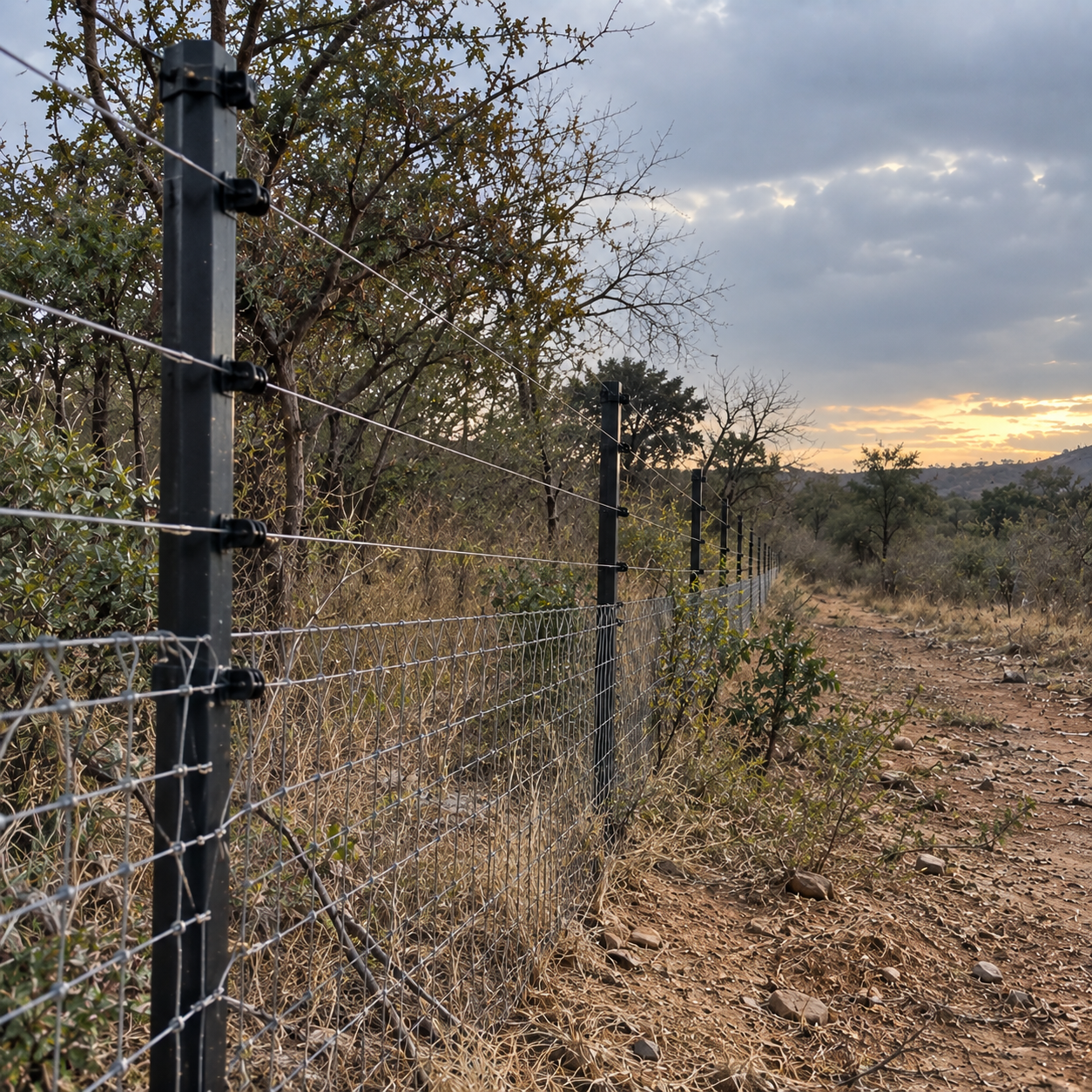
An electric fence on a wildlife estate has to do more than deliver a deterrent. It has to remain functional outdoors, work with the physical boundary beneath it, cope with vegetation and weather, and fit into an environment where wildlife is part of everyday life.
That makes the installation quite different from putting electric strands around an ordinary suburban wall.
On a Lowveld estate, a fence may run alongside bush, cross uneven ground, pass close to roads and driveways, and connect to several gates or access points. Some sections may protect homes, while others run along open areas where maintenance access is more difficult. The same property can therefore have very different perimeter requirements from one section to another.
Premium Projects installs, repairs and upgrades electric fencing for wildlife estates, farms, lodges, homes and other properties across Hoedspruit, the Greater Kruger Area, Limpopo and Mpumalanga. Our approach is to consider the existing boundary, access points, vegetation, ground conditions and the way the property is actually used before determining the appropriate setup.
Need Electric Fencing for a Wildlife Estate?
Tell us about the property, existing boundary and areas that need additional protection. We can help you assess a practical electric fencing solution for the site.
Why electric fencing needs to be planned differently on a wildlife estate
A wildlife estate is not simply a residential development with bigger gardens.
There may be natural vegetation between properties, animals moving through shared spaces, larger plots, long boundary sections and rules governing how individual properties can be altered. In some areas, the visual appearance of the property is also part of the character of the estate.
The fence therefore has to perform its security function without creating unnecessary problems elsewhere.
For example, vegetation growing into the electric strands can repeatedly trigger faults. A gate positioned across a frequently used driveway needs a different arrangement from a rarely used service entrance. A boundary that follows uneven ground may need more careful attention to how the physical fence and electric components are supported.
The existing fence matters too.
Electric fencing is generally an active security layer installed on or alongside a suitable physical boundary. Premium Projects installs electric fencing on suitable walls, clearview fencing, palisade fencing and other security boundaries, depending on the property and installation requirements.
That means the quality and condition of the underlying boundary should be considered before adding electric fencing.
A damaged fence with loose posts or weak sections does not become a sound perimeter simply because electric wires have been added to it.
How electric fencing fits into the perimeter
Electric fencing works by using an energiser to send controlled electrical pulses through the live fence wires. When the circuit is properly completed, contact with the live conductor can create a deterrent shock.
The energiser is only one part of the system.
The wires, insulators, brackets, connections, earth system, supporting structure and gate arrangements all have to work together. If one part is compromised, the overall performance can suffer.
This is why simply buying a powerful energiser is not necessarily the answer to a poorly performing fence.
A wildlife estate can have a surprisingly long perimeter once individual properties, internal boundaries and additional protected areas are taken into account. The system therefore needs to be planned according to the actual fence layout and required level of protection.
Premium Projects considers factors including the existing boundary, gates, corners, buildings, vegetation, ground conditions and areas requiring additional protection when planning electric fencing installations.
That site assessment is particularly useful where the fence is being added to an existing property rather than installed as part of a completely new boundary.
The physical fence still matters
Electric fencing should not be viewed as a substitute for every other type of fencing.
A physical fence establishes the actual boundary. The electric system adds another layer of security.
This distinction becomes especially relevant on wildlife estates because different parts of a property may have different functions.
A homeowner may have a palisade or clearview boundary around the house, while the wider property sits within a wildlife estate that has its own perimeter arrangements. Another property may have a mesh or other suitable physical fence that can accommodate an electric fencing upgrade.
The correct combination depends on the site.
Premium Projects also installs clearview, palisade, game, farm and wire mesh fencing, allowing the physical boundary and electric security layer to be considered together where appropriate.
This can be particularly useful when an existing fence has deteriorated. It may be possible to repair or strengthen the boundary before adding or upgrading the electric system, rather than replacing everything unnecessarily.
Wildlife movement needs to be considered
A wildlife estate introduces something that an ordinary suburban property does not: animals are part of the environment.
That does not mean every electric fence on a wildlife estate is unsuitable. It means the installation needs to take the surrounding environment and applicable estate requirements seriously.
The exact arrangement should depend on the property, its boundary, the animals present and the rules governing the estate.
A fence may border natural vegetation, a road, a neighbouring property or an open section used by wildlife. Those surroundings should be considered when deciding where the electric system is appropriate and how it should be installed.
Game fencing itself also needs to be designed around the species, terrain and purpose of the boundary. Premium Projects notes that wildlife fencing can have different requirements depending on the animals being contained or excluded, with mesh spacing, height, wire strength and support structures all affecting the installation.
Electric fencing should therefore not be treated as a standard add-on that is identical on every wildlife property.
Estate rules can affect the installation
This is an easy point to overlook.
Some wildlife estates, managed communities and conservation-sensitive properties have their own requirements relating to fencing, appearance, alterations and security installations. Approval may be required before an existing boundary is changed or electric fencing is installed.
Premium Projects specifically notes that electric fencing installations in estates, managed communities, wildlife developments and conservation-sensitive areas remain subject to the applicable property rules and approval requirements.
So before work begins, check what the estate allows.
This can prevent a situation where a property owner installs a technically suitable system only to discover that the positioning, appearance or configuration does not comply with the estate’s requirements.
The same principle applies when buying a property with an existing electric fence. It is worth establishing what is already installed, whether the system is functioning correctly and whether previous alterations were approved where approval was required.
Vegetation is one of the practical challenges
A fence can work perfectly after installation and start causing problems later because vegetation has changed.
This is particularly relevant in the Lowveld, where fences are exposed to outdoor conditions and natural vegetation.
Branches can press against fencing. Grass and other growth can reach the lower wires. Climbers can become entangled in sections of the boundary. Over time, this can result in recurring faults and make it more difficult to inspect the fence properly.
Premium Projects highlights vegetation management as an important part of electric fence maintenance because uncontrolled growth can come into contact with the strands and create recurring faults.
The answer is not necessarily to remove all vegetation around the property.
The more practical approach is to maintain enough clearance around the relevant fence sections so that the system remains accessible for inspection and does not have constant contact with growing plants.
This also makes it easier to spot physical damage.
A fence hidden behind dense growth is much harder to inspect than one where the wire, insulators and supporting structures can be seen clearly.
What happens when an electric fence keeps failing?
Repeated faults should not simply be accepted as part of owning a wildlife property.
A fence that repeatedly loses power or triggers faults may have an underlying issue that needs to be identified.
The problem could involve damaged wiring, poor connections, vegetation, insulators, earthing, physical damage or another component of the installation. Replacing one part without finding the underlying cause may only provide a temporary improvement.
Premium Projects provides electric fence repairs and upgrades, including work such as replacing damaged wiring, improving earth connections, replacing worn insulators, repairing weak sections and improving gate crossings.
An upgrade may also make sense when an older system no longer suits the property.
For example, the estate may have changed since the original installation. A new building may have been added, the entrance may have been altered, or additional areas may now require protection.
In those circumstances, repeatedly repairing an old configuration may not be the most practical approach.
Is Your Existing Electric Fence Giving You Problems?
Recurring faults, damaged wires and worn components can make an older system unreliable. We can assess the existing installation and discuss repair or upgrade options.
The gate is part of the electric fence system
A perimeter is only as secure as its vulnerable openings.
Gates are therefore an important part of the planning process.
A vehicle entrance needs to remain usable while still maintaining the security of the surrounding boundary. There may also be pedestrian gates, service entrances and areas used by contractors or maintenance staff.
Electric fencing needs to be installed around these points in a way that works with the gate rather than interfering with its normal operation.
This is one reason the gate should be considered before the electric fence installation is finalised.
Premium Projects installs sliding gates, swing gates, pedestrian gates, farm gates and service gates, and can combine gate installation with gate automation and other perimeter security systems where appropriate.
For a wildlife estate, this can be particularly useful where residents, guests, staff and service providers all use the property at different times.
A manually operated gate may be sufficient for one property. Another may benefit from a motorised gate with controlled access.
The right choice depends on how the entrance is used.
Electric fencing can work with CCTV and access control
There is a difference between preventing unauthorised access and knowing what is happening at the entrance.
That is where other security systems can complement the electric fence.
CCTV can provide visibility around gates, driveways, parking areas, building approaches and selected perimeter sections. Access control can help manage who is permitted to enter. An intercom can provide a way to communicate with visitors before granting access.
Premium Projects installs CCTV, access control and intercom systems alongside fencing and gate solutions where required. The company describes these systems as part of a coordinated perimeter-security approach rather than isolated installations.
Consider a wildlife estate home where the main entrance is several metres from the house.
An electric fence may provide the active perimeter layer. A camera at the gate can show who has arrived. An intercom can allow communication with the visitor. A gate motor can control the physical opening, while access control can determine who is authorised to enter.
Each component has a different job.
That can be more useful than expecting one security device to do everything.
Power supply matters more on remote properties
Electric fencing depends on an energiser, which means the power arrangement deserves attention during planning.
A property may have reliable mains electricity, but power interruptions still need to be considered. Some wildlife estates and rural properties may also have areas where extending conventional power infrastructure is impractical.
Premium Projects offers solar and battery backup solutions for security systems, including electric fencing, gate motors, CCTV, access control and intercoms.
The appropriate backup arrangement depends on the equipment, usage and site conditions.
For example, a gate motor that opens several times a day has different energy requirements from a system that operates continuously. Similarly, a CCTV installation may have additional power requirements depending on the number of cameras and supporting equipment.
The important point is to consider backup during the initial planning rather than treating it as an emergency addition after repeated power interruptions.
Where should electric fencing be installed?
There is no universal layout that works for every wildlife estate.
One property may need protection around the complete residential boundary. Another may need stronger security around the house, garage, workshop and storage areas while using a different boundary solution elsewhere.
The layout should follow the actual security requirements.
Areas that may deserve particular attention include:
- Main vehicle entrances and secondary service gates
- Residential boundaries
- Garages and storage areas
- Workshops and equipment areas
- Sections where the existing physical boundary is more vulnerable
- Areas that are difficult to monitor from the house
- Perimeter sections where unauthorised access would be particularly easy
That does not mean every one of these areas automatically needs electric fencing. The purpose is to identify where an additional security layer would make sense.
A wildlife estate can have a large boundary, but the highest-value assets may occupy only a small part of the property.
Security planning should reflect that.
Maintenance is part of the installation
An electric fence should not be installed and then forgotten.
Outdoor systems are exposed to the same environment every day. Dust, weather, vegetation, animals, accidental physical damage and general wear can all affect the fence.
Regular inspection makes it easier to spot problems before they become larger failures.
Look for obvious physical damage, vegetation touching the wires, loose or damaged components and areas around gates where movement or repeated use may have affected the installation.
The frequency of inspection depends on the property.
A boundary surrounded by fast-growing vegetation or exposed to frequent wildlife activity may need more attention than a relatively clear section around a house.
Premium Projects provides electric fence maintenance as well as repairs and upgrades, with maintenance requirements assessed according to the property and environmental conditions.
Maintenance also matters when an estate property is unoccupied for periods of time.
A holiday home or investment property may stand empty for weeks while the perimeter remains exposed to the elements. Having the system inspected periodically can help identify problems that would otherwise go unnoticed.
When should an existing system be upgraded?
Sometimes a repair is enough.
A damaged wire, worn insulator or isolated section of physical damage may not justify replacing an entire installation.
An upgrade becomes more relevant when the same problems keep returning or when the system no longer matches the property.
For example, an older installation may have been designed when the property had fewer buildings and a different entrance arrangement. New construction may have created additional vulnerable areas. The original fence may also have deteriorated to the point where its supporting structure is no longer suitable.
Premium Projects identifies several possible components of an electric fence upgrade, including wiring, earthing, energisers, insulators, gate crossings, brackets and integration with other security equipment.
The decision should be based on the condition and purpose of the existing system rather than simply its age.
Electric fencing is not always the answer everywhere
This is worth saying clearly.
Adding electric fencing to every available boundary is not automatically the best security decision.
Some areas may benefit more from improved physical fencing. Others may need better gate control, lighting, CCTV or access control. A property with a damaged boundary may need repairs before an electric system can perform properly.
There can also be areas where estate rules or environmental considerations affect what is permitted.
The most useful question is therefore not, “Where can we put electric fencing?”
It is, “Where would an additional active security layer actually improve this property’s perimeter?”
That distinction keeps the project practical.
Choosing an electric fencing installation for a Lowveld wildlife estate
A wildlife estate has its own combination of property layout, vegetation, access requirements and environmental conditions.
Before an installation, it is useful to establish:
- What physical boundary already exists
- Which sections need additional security
- Where vehicles and pedestrians enter
- Whether there are separate service entrances
- Where vegetation could interfere with the fence
- What power supply is available
- Whether backup power is required
- Whether CCTV, access control or gate automation should form part of the wider system
- What estate or community approvals apply
- How the fence will be accessed for future maintenance
The answers can change the design considerably.
For one property, the solution may be a straightforward electric fence upgrade along an existing boundary. Another may require repairs to the physical fence, new electric fencing around selected sections, gate automation, CCTV and backup power.
Premium Projects plans fencing and electronic security around the actual property rather than applying one standard design to every site.
That approach is particularly relevant in the Lowveld, where properties can differ significantly in size, terrain, vegetation and use.
Electric fencing in Hoedspruit and the Greater Kruger Area
Premium Projects provides electric fencing installation, repairs and upgrades across Hoedspruit, the Greater Kruger Area and surrounding parts of Limpopo and Mpumalanga. The service includes wildlife estates, farms, lodges, guest properties, homes and commercial sites.
The company also works in areas including Marloth Park, Mjejane Game Reserve, Lionspruit, Ngwenya, Hectorspruit, Malelane, Komatipoort, White River and Mbombela/Nelspruit, among other Lowveld locations.
For properties within wildlife estates and other managed communities, the installation remains subject to the relevant estate rules and approval requirements.
That local context matters because a security system should work with the property rather than against it.
A good electric fence starts with the boundary underneath it
The most effective electric fencing projects are not necessarily the ones with the most wires or the largest energiser.
They are the ones where the complete perimeter has been considered.
The physical fence needs to be suitable. Gates need to remain functional. Vegetation needs to be manageable. The power supply needs to be reliable. Areas requiring greater protection need to be identified. And the system needs to remain accessible for maintenance.
On a wildlife estate, there is another layer to consider: the relationship between the property and its surrounding environment.
That is why an electric fence should be treated as part of the property’s wider security setup rather than as an isolated product.
Premium Projects can assess the existing boundary and discuss whether a new electric fence, repair, upgrade or combination of fencing and electronic security systems is appropriate for the property.
Conclusion
Electric fencing can add a useful active security layer to a wildlife estate, but the installation needs to be suited to the property around it.
The condition of the existing fence, the position of gates, vegetation, power supply, wildlife movement, maintenance access and estate requirements all influence how the system should be planned.
There may also be no reason for every section of the property to receive exactly the same treatment. One area may need stronger physical fencing, another may benefit from electric fencing, while the entrance may require a combination of gate automation, CCTV and access control.
For Lowveld wildlife estates, that property-specific approach is important. A perimeter has to provide security while still functioning as part of a real property that people, vehicles, staff and wildlife move through every day.
Strengthen Your Wildlife Estate Perimeter
If your existing fence needs an electric upgrade, repair or additional security layer, share the property details with us and we can discuss the practical options.