
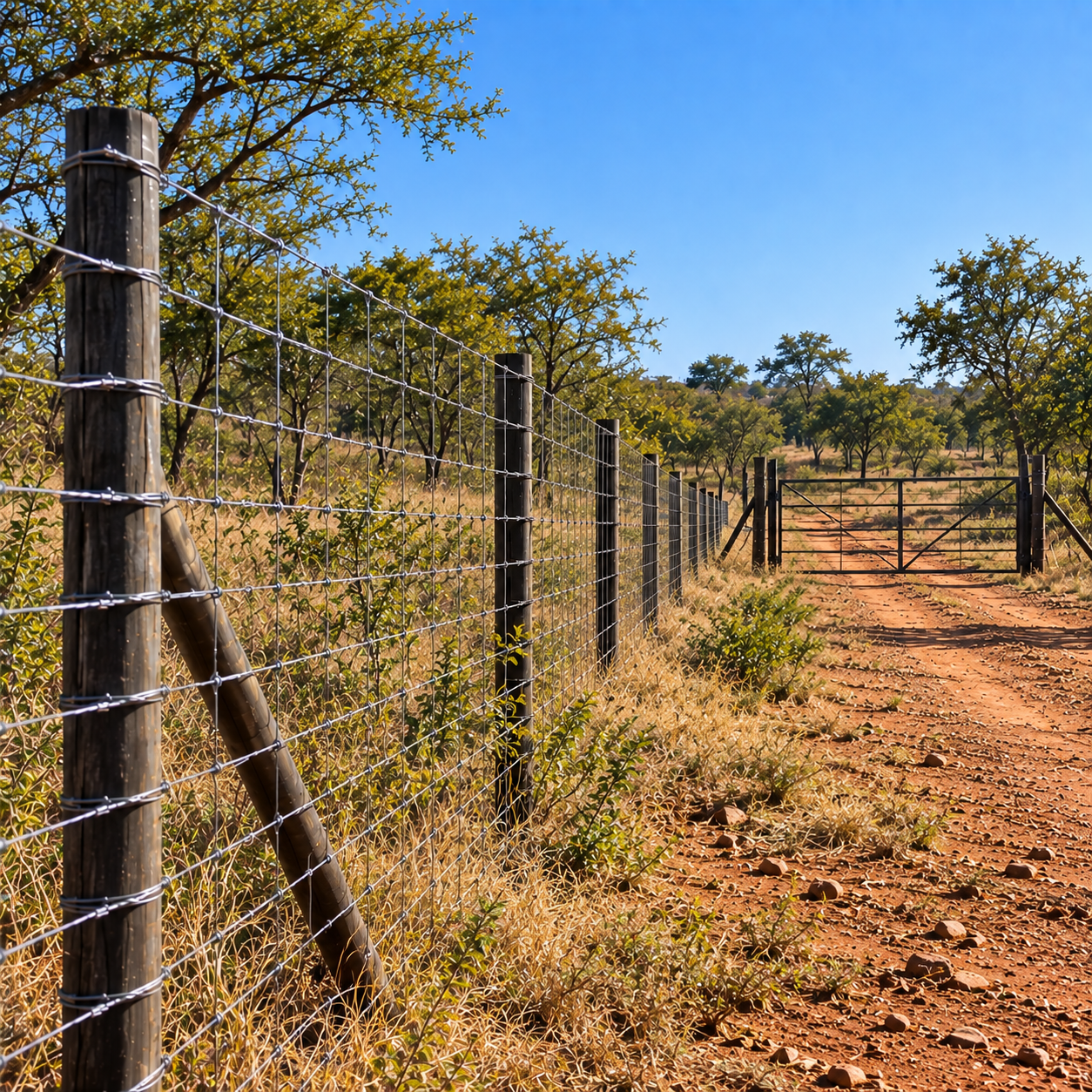
A fence on a Lowveld property has a harder job than simply marking where one piece of land ends and another begins. A boundary may need to contain livestock, guide animal movement, protect crops, keep vehicles on designated routes, secure equipment or separate a farmhouse from the working areas of the farm.
Then there is the terrain.
A fence line might cross rocky ground, a slope, softer soil, a riverbed or an area where vegetation grows quickly. A solution that works perfectly along one section of a property may be completely unsuitable a few hundred metres away.
That is why farm and game fencing needs to be planned around the property itself, rather than choosing a fence type simply because it is widely used.
Tell Us What Your Property Needs
Share your location, the type of property and what you need the fence to achieve. We can help you work out which fencing solution makes sense for the site.
Start with what the fence needs to do
The first question should not be, “Which fence looks best?”
It should be, “What is this fence actually being asked to achieve?”
A game farm boundary, for example, has different requirements from a cattle camp. A fence around an orchard may be designed primarily to keep animals out, while fencing around a farmhouse or workshop may have security as its main purpose.
On larger properties, there may not be one single answer. Different sections can require different fencing.
Premium Projects works with agricultural properties, game farms, wildlife properties, lodges and rural properties across the Lowveld, Limpopo and Mpumalanga. Our game and farm fencing service covers new installations as well as repairs, strengthening and replacement of existing fencing where required.
The main options worth considering include game and farm fencing, wire mesh fencing, electric fencing, palisade fencing and clearview fencing. Each has a different role.
Game fencing for larger wildlife properties
Game fencing is generally the starting point when the purpose of the boundary is to manage wildlife movement across a larger area.
The exact fence specification depends on the animals on the property, the surrounding land use and what the fence needs to prevent or contain. A fence designed for one type of game should not automatically be assumed to be appropriate for another.
There is also a difference between the outer boundary of a game property and internal fencing.
An external boundary may need to cover a considerable distance and cope with changing terrain. Internal fencing can instead be used to divide sections of the property, manage animal movement or create separate areas for particular purposes.
The practical side of the installation matters too. Long fence lines need accessible routes for inspection and maintenance. Corners and changes in direction need to be properly supported. Gates need to suit the vehicles using them, particularly where tractors, trailers, game vehicles or other large vehicles regularly pass through.
For a large property, these details can make the difference between a fence that works well in everyday operations and one that becomes difficult to maintain.
Why the terrain matters
Lowveld properties are not uniformly flat or easy to work with. A fence route can encounter changes in elevation, rocky sections, vegetation, drainage paths and other natural features.
The fence has to follow the land without creating weak points.
Posts, strain points and foundations need to be considered according to the ground conditions. Simply measuring a straight line from one end of the property to another does not tell you everything that is involved in installing the fence.
This is particularly important on larger farms because small planning mistakes are repeated over a much longer distance.
Farm fencing for livestock and agricultural land
Livestock fencing has a different priority from wildlife boundary fencing.
The animals need to be contained safely, while the farmer still needs practical access between camps, water points, handling areas and other parts of the property.
Cattle, sheep and goats do not interact with fencing in exactly the same way. Smaller animals may exploit gaps that larger livestock cannot, while stronger animals can put considerable pressure on posts and wire when they push against a boundary.
Internal fencing can therefore be used to create camps and paddocks suited to the way the farm operates.
This can be useful for separating grazing areas, keeping animals away from crops, managing different groups of livestock or controlling movement around buildings and roads.
The location of gates becomes especially important here. A gate that is technically functional can still be poorly positioned if it forces farm vehicles or livestock to take an awkward route.
Premium Projects considers the animals, terrain, access roads, existing infrastructure and day-to-day use of the farm when planning agricultural fencing.
Wire mesh fencing has a different role
Wire mesh or diamond mesh fencing can be useful where a property needs a more contained barrier for a particular section rather than a large game boundary.
For example, mesh fencing can be used around:
- Gardens and cultivated areas
- Staff areas
- Storage yards
- Internal farm sections
- Smaller animal enclosures
- Residential areas within a larger rural property
The mesh specification still needs to suit the purpose. There is little value in installing a fence with openings that allow the very animals you are trying to keep in or out to pass through.
Mesh can also be useful when a farm contains several different areas with different requirements. A property may have a larger farm boundary, livestock camps and a more secure enclosure around the farmhouse or equipment area.
That combination can make more sense than using the same fencing throughout the entire property.
Premium Projects provides wire mesh and diamond mesh fencing for farms, rural properties, lodges, yards and other sites in the Hoedspruit and Greater Kruger areas.
Need Help Choosing the Right Fence?
A large property can have several fencing requirements at once. Tell us what you need to contain, protect or separate, and we can discuss a practical approach for the different areas.
Electric fencing is usually a security layer, not a replacement for everything else
Electric fencing is often discussed as though it is a complete boundary solution on its own. In practice, it can be much more useful when considered as part of a wider perimeter system.
On a farm, there may be certain areas where stronger security is needed than the general agricultural boundary provides.
Think about the farmhouse, workshop, equipment yard, storage area, pumps, generators or other valuable infrastructure. These areas may benefit from an additional security layer without requiring the entire farm to be enclosed to the same high-security specification.
Electric fencing can also be installed alongside other fencing types where the property requires additional perimeter protection.
The surrounding environment matters here as well. Long fence lines, vegetation, weather and physical damage can affect an electric fence’s reliability. The system needs appropriate installation, maintenance and attention to vulnerable sections.
Premium Projects installs, repairs, maintains and upgrades electric fencing for farms and rural properties, including properties around the Lowveld.
Where electric fencing makes more sense
It is particularly worth considering around areas where unauthorised access would have greater consequences.
A farm does not necessarily have the same security requirements at every point. A remote boundary, farmhouse, workshop and staff area can all present different risks.
This is where a layered approach becomes useful.
A farm might have a conventional agricultural or game boundary around the wider property, stronger fencing around selected buildings and an electric fence around a particularly sensitive area. Gates, CCTV and access control can then be added where they make practical sense.
The result is a system designed around the property instead of an expensive attempt to make every metre of fencing identical.
Palisade fencing can protect high-value areas
Palisade fencing is generally more suited to sections where physical security is a priority rather than long-distance agricultural boundaries.
On a farm, that could mean the area around a farmhouse, workshop, storage facility, depot, equipment yard or other valuable infrastructure.
It provides a visible physical barrier and can be used to create a more secure zone within a much larger property.
This distinction is important. A farm might have kilometres of boundary fencing but only a relatively small area that needs the level of physical security associated with palisade fencing.
Using the appropriate fence in each location can make the overall project more practical.
Premium Projects installs palisade fencing for farms, lodges, homes, commercial sites, workshops and other properties across Hoedspruit and the Greater Kruger Area.
Clearview fencing has a more specific purpose
Clearview fencing is another option for selected areas of a farm or game property, particularly where security and visibility both matter.
The open design allows people to see through the boundary instead of creating a solid visual barrier. That can be useful around entrances, buildings, parking areas, staff sections and other controlled areas.
It is not necessarily the first choice for a long game boundary, however. Its usefulness depends on what the particular section of the property needs to achieve.
For example, a farm could use agricultural fencing across its wider land while using clearview fencing around a residential or operational area where visibility is important.
Premium Projects installs clearview fencing for farms, wildlife properties, lodges, estates and commercial sites in the Greater Kruger region.
The best fencing solution may be a combination
This is probably the most important point for large rural properties.
There is no rule saying the whole property needs to use one fencing type.
A typical property may have:
Outer boundary: Game or farm fencing suited to the animals, land and length of the boundary.
Internal camps: Farm fencing designed around livestock movement and grazing management.
Cultivated areas: Mesh or another suitable barrier where crops need protection.
Farmhouse: A more secure fencing solution where residential security is a concern.
Workshop and equipment yard: Palisade, electric fencing or another combination depending on the security requirements.
Entrance: A properly sized gate that accommodates the vehicles and equipment using the property.
This approach also allows money and effort to be concentrated where they are actually needed.
A remote section of grazing land does not necessarily need the same security specification as a workshop containing expensive equipment.
Do not overlook the gates
A strong fence can still have a weak entrance.
On farms, gates need to accommodate more than people and ordinary cars. Tractors, trailers, livestock vehicles, bakkies, delivery vehicles and maintenance equipment may all need access.
The gate therefore needs to be considered alongside the fence rather than treated as an afterthought.
The opening needs to be practical for the vehicles using it, while the gate itself needs to work with the surrounding fencing and the way traffic moves through the property.
On a large farm, it can also be useful to separate main entrances from service entrances or create controlled access to particular sections.
Where automated access is appropriate, the gate can become part of a wider security system involving gate motors, intercoms, CCTV or access control. Premium Projects provides gate installation in Hoedspruit and the Greater Kruger Area for farms, game reserves, lodges, wildlife estates and other properties.
Repairing an existing fence may be the sensible option
A fence does not automatically need to be replaced because it is old.
Sometimes the underlying structure is still sound and only certain sections have deteriorated. Broken wires, loose posts, damaged mesh, weak corners or problems around gates can potentially be addressed without replacing the entire installation.
There is a point, however, where repeated repairs stop making practical sense.
If posts are failing along long sections, the fence specification no longer suits the animals or land use, or the property has changed significantly since the original installation, replacement may be the better option.
The condition of the existing fence should therefore be assessed before deciding between repair, strengthening and complete replacement.
Premium Projects also provides fence repairs and maintenance for farms, game properties, lodges and other rural sites.
Pay particular attention to these areas
Fence problems are not always evenly distributed.
Gates, corners, long straight runs, areas near roads, sections exposed to vegetation and places where animals regularly push against the fence can experience more wear than other parts.
These areas deserve closer inspection during maintenance.
A small failure on a remote fence line can also become a much larger problem if it is not noticed for some time. For large properties, having practical access to the fence route makes regular inspections considerably easier.
What should you consider before choosing a farm fence?
Before deciding on the final specification, look at the property as a working environment rather than just an empty piece of land.
Consider:
- What animals are on the property and what needs to be contained or excluded
- Whether the fence is an outer boundary or an internal division
- The length of the fence line
- Changes in elevation and ground conditions
- Existing roads, water points, buildings and infrastructure
- The vehicles and equipment that need access
- Areas requiring additional security
- How the fence will be inspected and maintained
- Whether gates may need automation or controlled access in the future
These considerations can change the appropriate fencing solution considerably.
For instance, a fence around a small equipment yard has a very different job from a boundary extending across a large game farm. Treating both as the same fencing project simply because they are on the same property can lead to unnecessary expense or an unsuitable installation.
Choosing fencing for the Lowveld environment
The Lowveld environment adds another practical consideration.
Outdoor fencing is exposed continuously. Dust, weather, vegetation, animals, vehicle movement and general wear all affect the installation over time.
A fence that looks perfectly straight and secure on the day it is installed still needs maintenance afterwards.
Vegetation should be managed around relevant sections. Gates and high-use areas should be checked for wear. Damaged wire or mesh should not simply be left because the rest of the fence remains intact.
For electric fencing, vegetation and other environmental factors can also interfere with system performance, making maintenance particularly important.
The aim is not to create a fence that never needs attention. The aim is to install something appropriate to the property and make it practical to maintain.
A fencing project should start with the property, not the product
A farm owner looking at fencing options can easily end up comparing wire types, mesh, posts and fence heights before considering the bigger picture.
That is backwards.
Start with the land.
Where are the animals? Where do vehicles travel? Which areas contain valuable equipment? Where are the buildings? Which sections need to be separated? Where are the gates? What happens when the property expands or its use changes?
Once those questions are answered, the appropriate fencing types become much easier to identify.
For some properties, that may mean game fencing around the boundary and agricultural fencing internally. For others, mesh, electric fencing, palisade or clearview fencing may be added around specific areas.
At Premium Projects, we assess the proposed fence route, entrances, corners, changes in elevation and existing structures before recommending a suitable installation.
That matters on a Lowveld property because fencing is not just a boundary. It becomes part of how the land is managed.
Fencing solutions for farms and game properties across the Lowveld
Premium Projects provides game and farm fencing, fencing installation, repairs and related perimeter security solutions across Hoedspruit, the Greater Kruger Area and surrounding parts of Limpopo and Mpumalanga.
The wider property may need one type of fence, while the farmhouse, workshop, livestock camps, storage areas or entrances need something different. We can help plan the fencing around those practical requirements rather than applying one solution to every section.
Where appropriate, fencing can also form part of a wider security setup involving gates, electric fencing, CCTV, access control and other perimeter security measures.
Conclusion
The right farm or game farm fence depends on what is happening behind it.
A wildlife boundary needs to account for animal movement and the scale of the property. Livestock fencing needs to work with camps, grazing and daily farm operations. Crop areas may require a different barrier, while equipment yards, houses and workshops can justify a stronger security layer.
That is why the best fencing project is not necessarily the one that uses the strongest or most expensive fence everywhere. It is the one where each section has been designed around its actual purpose, terrain and use.
For a Lowveld property, that planning becomes even more important when long fence lines, changing ground conditions, gates, animals and remote areas all form part of the same project.
Plan the Right Fence for Your Property
If you are unsure whether your farm needs game fencing, livestock fencing, mesh, electric fencing or a combination, share your requirements with us and we can discuss suitable options.