
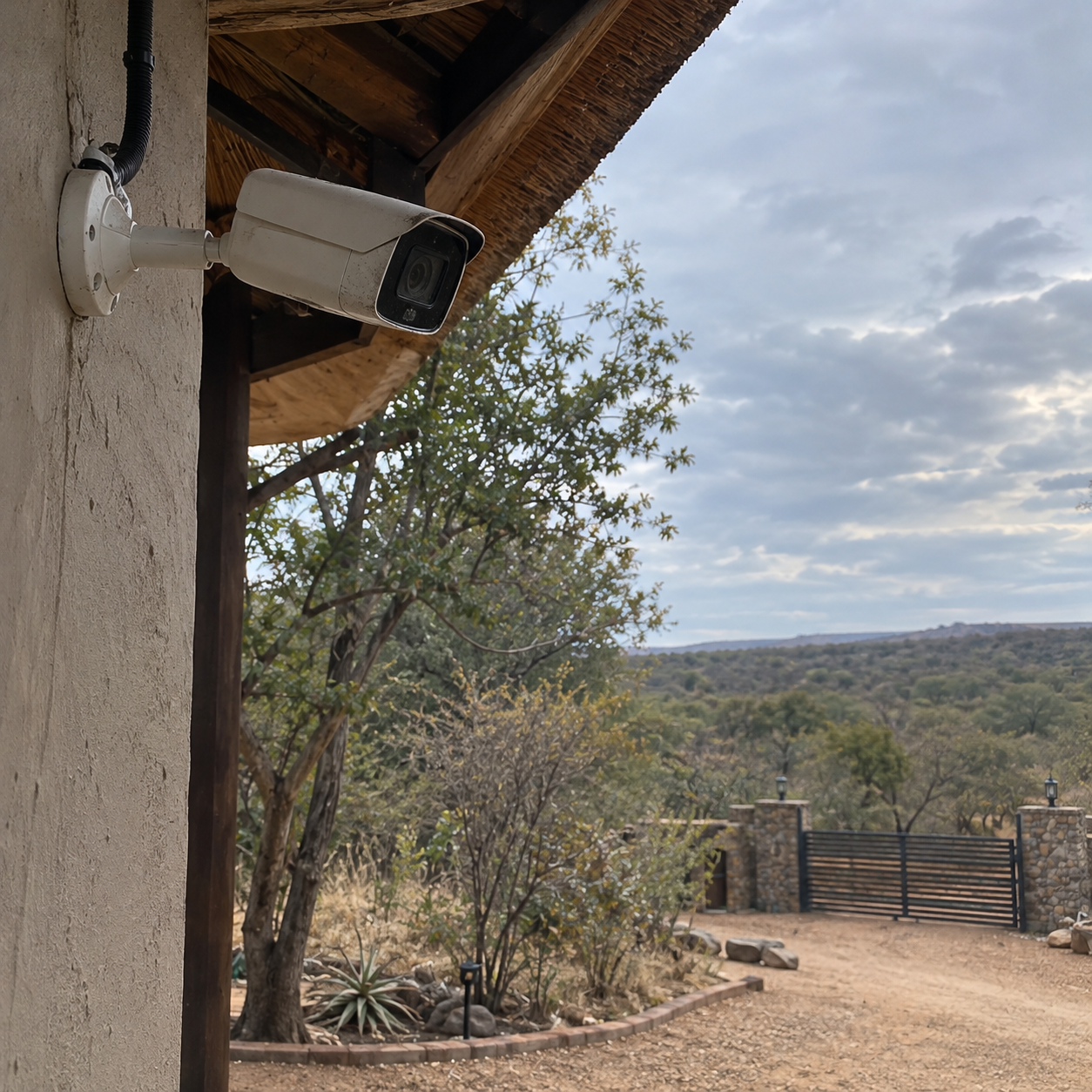
A camera at the main gate can show who entered a property, but what happens when a vehicle turns off the driveway and heads towards the workshop? Or when a delivery arrives at the back entrance while the manager is busy elsewhere? On a large rural property, the areas that matter most are not always visible from the main house or reception.
Lodges, farms and rural properties have different security requirements from typical suburban homes. Buildings may be spread across a large area, equipment might be stored outdoors, and entrances can be some distance from the people responsible for monitoring them. A camera system that works well around a small house may not provide useful coverage across a working farm or hospitality property.
CCTV installation needs to account for these differences from the beginning. Camera placement, lighting, recording equipment, internet connectivity, power supply and the daily movement of people and vehicles all influence how useful the finished system will be.
At Premium Projects, we install CCTV systems for properties across Hoedspruit, the Greater Kruger Area and surrounding parts of Limpopo and Mpumalanga. We consider the layout of the property, the areas requiring monitoring and how CCTV can work alongside existing gates, electric fencing, access control and other security measures.
The aim is not to cover every available surface with cameras. It is to establish useful visibility where it matters most.
Get a CCTV Installation Quote
Tell us about your property and CCTV requirements, and we’ll help you find a suitable solution.
CCTV for lodges, where guest security meets daily operations
A lodge has two environments to consider: the areas guests use and the operational spaces that keep the property running.
Guest accommodation, reception, parking areas and main walkways may need security monitoring, but so might staff entrances, laundry facilities, maintenance yards, storage rooms and delivery areas. These operational spaces can experience regular movement without always being visible from reception or the manager’s office.
The difficulty is deciding where cameras will provide genuinely useful information without unnecessarily intruding on guests.
A camera at the entrance, for instance, can help establish when visitors or suppliers arrive. Cameras positioned around guest parking can provide visibility over vehicle movement. A separate camera covering a service entrance may help management review activity around deliveries and staff access.
Back-of-house areas deserve particular attention. Equipment, cleaning supplies, tools and maintenance materials may be stored away from the main guest areas. If a storeroom is accessed through a side passage or an external door, a camera positioned to capture that approach may be more useful than one pointed at a general outdoor space.
CCTV placement should respect privacy. Cameras should not be installed inside bedrooms, bathrooms or other private guest spaces. Staff accommodation and other private areas also require careful consideration. Monitoring should focus on legitimate security needs, with appropriate access to recordings and clear rules about how footage is used.
The layout will depend on the type of lodge, its buildings, vehicle access and the way staff and guests move through the property.
Premium Projects already works with lodge security requirements through its wider perimeter security services. Our article on security solutions for lodges in Hoedspruit and the Greater Kruger Area explores how different security measures can work together across hospitality properties.
CCTV installation for farms and agricultural properties
A farm can have dozens of potential camera positions, but that does not mean every one needs a camera.
The main entrance may be the obvious starting point. Beyond it, the property could have machinery sheds, workshops, fuel storage, irrigation pumps, generators, livestock handling facilities, staff accommodation, storage buildings and vehicle yards. Some of these areas contain valuable equipment, while others experience frequent movement from workers, contractors and suppliers.
A useful CCTV system begins by identifying which areas deserve priority.
Monitoring equipment and machinery
Farm equipment is not always stored in a locked building. Tractors, trailers, implements and machinery may be parked under open-sided shelters or in designated yards. Pumps, generators and irrigation equipment may be positioned even further away from the main buildings.
These locations present a different camera-placement challenge from a conventional storeroom.
A camera needs a clear view of the relevant access route or equipment area. If it is positioned too far away, the footage may show movement without providing enough detail to identify what happened. If it is aimed at the wrong angle, a vehicle or person may be obscured by a building, parked machinery or vegetation.
For example, a camera covering a machinery shed should be positioned with the entrance and approach in mind. A separate view of the surrounding yard might be useful if vehicles or equipment are regularly moved between buildings.
Where several assets are spread across a large farm, it may be more practical to secure the main equipment yard and selected high-value areas first, then extend coverage where the remaining risks justify it.
Farm gates and access roads
The main gate is often one of the most valuable places to install CCTV because it provides a point at which vehicles and people enter or leave the property.
However, capturing an image of a vehicle is not necessarily the same as obtaining useful footage of its occupants or registration plate. Distance, camera angle, vehicle speed, lighting and the direction of travel all affect the result.
A wide-angle camera can provide an overview of the entrance, while a more specifically positioned camera may be needed for clearer identification. The appropriate setup depends on the entrance and what the owner needs the footage to establish.
Long access roads introduce another consideration. A single camera at the gate cannot show what happens several hundred metres further along the road. Where a property has multiple entrances or separate operational areas, additional cameras may be justified at selected points.
The goal is to make the entrance and important movement routes easier to monitor, rather than assuming one camera can cover the entire farm.
Workshops, fuel areas and storage buildings
Workshops and storage facilities often contain tools, spare parts, chemicals, machinery components and other valuable materials. Fuel storage and generator areas can also warrant attention because of the equipment and operational importance involved.
Cameras should be positioned to cover the entrances, approaches and areas where movement needs to be recorded. For enclosed buildings, an external camera may show who entered, while an additional camera inside an appropriate working or storage area could provide more detail where lawful and suitable.
The exact arrangement depends on the nature of the facility, access permissions and any safety requirements associated with the equipment or materials stored there.
Premium Projects provides CCTV installation for farms and rural properties and can help identify which parts of a property should receive priority when planning a new system or improving an existing one.
Rural properties need a different approach to camera placement
A rural property may have a farmhouse, several outbuildings, a workshop and a long driveway, all separated by open ground or natural vegetation. Some buildings may be visible from the main house, while others sit behind a bend in the road or beyond a line of trees.
This layout affects both the number of cameras required and where they should be installed.
A camera mounted on the house might provide an excellent view of the front entrance but very little visibility around a detached garage. Similarly, a camera covering a driveway may miss a side gate because the boundary wall blocks the view.
Walking through the property and identifying these blind spots is an important part of planning.
It also helps to consider how the property is used at different times. A driveway may be busy during the day but poorly lit at night. A service entrance may only be used by contractors on certain days. A remote storeroom may be left unattended for long periods.
These details influence which camera positions are most useful.
Where cameras are likely to provide the most value
On rural properties, useful locations often include the main entrance, vehicle parking, external doors, workshops, storage areas, service entrances and selected sections of the boundary. Properties with multiple buildings may also benefit from cameras covering the routes between operational areas.
That does not mean every property needs the same arrangement. A smallholding with one house and a workshop has different requirements from a farm with several operational buildings spread over a large area.
The important consideration is whether the proposed camera positions provide the visibility needed to monitor movement and review incidents.
A camera should have a clear purpose. If nobody can explain what area it needs to cover or what information it should capture, its position probably needs to be reconsidered.
Choosing CCTV cameras for outdoor conditions
Outdoor cameras are exposed to conditions that indoor equipment does not have to withstand. Heat, dust, rain, insects, wind and vegetation can all affect the installation.
In the Lowveld, these considerations are particularly relevant to cameras mounted along driveways, open yards, service roads and property boundaries.
A camera installed near an unpaved road may gradually accumulate dust on its lens or housing. Branches can grow into the field of view. A mounting point that seems suitable during installation may become less useful when vegetation changes or seasonal lighting shifts.
The camera itself also needs to be suitable for its intended environment. Outdoor protection, mounting arrangements and resistance to local weather conditions should be considered alongside image quality.
Resolution is only part of the decision
It is tempting to compare CCTV systems by looking at camera resolution alone. Higher resolution can provide more image detail, but it does not automatically guarantee useful footage.
A high-resolution camera positioned too far from the entrance may still fail to capture the detail needed to identify someone. Poor lighting, glare, motion and an unsuitable viewing angle can reduce the usefulness of the image.
Consider a driveway entrance where the objective is to identify vehicles. The camera needs to be positioned at a suitable distance and angle, with lighting that supports the required image quality. A camera chosen for a wide overview may not be the best option for capturing registration plates.
The same applies to a workshop. A wide view of the yard can show general activity, while a camera closer to the entrance may be better suited to recording people entering the building.
Camera selection should therefore follow the purpose of each view, not simply the specifications printed on the packaging.
Night-time CCTV requires more than a camera with night vision
An outdoor camera may provide clear images during the day but struggle after dark.
A lodge entrance illuminated by outdoor lights presents different conditions from a dark farm road with little ambient lighting. Headlights can create glare, bright lights can leave surrounding areas underexposed, and moving subjects may appear blurred if the camera is not suited to the conditions.
Night-time performance needs to be considered at the actual installation location.
For example, a camera positioned opposite a bright security light may have difficulty capturing useful detail in darker areas of the scene. A camera facing directly towards approaching headlights may also produce less useful footage than one installed at a more suitable angle.
Lighting should be assessed together with camera positioning. Depending on the location and camera type, existing lighting may be sufficient, or additional illumination may be appropriate.
Infrared night vision and other low-light technologies can help, but their performance depends on the equipment and the environment. Dust, rain, nearby reflective surfaces and the distance to the subject can affect the final image.
A practical installation should be assessed for both daytime and night-time conditions, particularly where the entrance, parking area or equipment yard is most active after dark.
Get a CCTV Installation Quote
Tell us about your property and CCTV requirements, and we’ll help you find a suitable solution.
What happens when the internet connection is unreliable?
This is a common concern for farms, lodges and rural properties outside well-connected urban areas.
Some CCTV systems use network connectivity for remote viewing, notifications and other connected functions. If the internet connection is unreliable, these features may be interrupted even when the cameras themselves remain powered.
However, internet access and local recording are not the same thing.
Depending on the equipment and system configuration, cameras can record footage to a local recorder or storage device without a continuous internet connection. Remote viewing may be unavailable during an outage, but locally stored footage can still be accessible when the system is operating correctly.
This distinction matters when planning CCTV for remote properties.
A farm owner may primarily need recordings that can be reviewed later. A lodge manager who is frequently away from the property may also want to check cameras remotely. These are different requirements and should influence the system design.
Before installation, establish whether remote viewing is essential, whether local recording is required, how long footage should be retained and what happens if the connection fails.
Remote viewing for owners and managers
Remote access can be useful when the person responsible for the property is not always on site.
A lodge owner may want to check the main entrance while away. A farm manager may need to review activity around an equipment yard without travelling to that section of the property. Someone responsible for a holiday property may want to confirm that the entrance and parking area remain visible between visits.
These functions depend on the camera system, recorder, network configuration and available internet connection.
Remote access should also be configured securely. Default passwords should be changed, access should be limited to authorised users, and software and equipment should be maintained appropriately. Giving every employee or contractor unrestricted access to every camera is rarely necessary.
The system should make monitoring more convenient without creating avoidable privacy or cybersecurity risks.
Recording equipment and storage matter just as much as the cameras
Cameras capture the footage, but the recording setup determines how that footage is stored and retrieved.
Depending on the system, recordings may be stored on a network video recorder, a digital video recorder or another supported storage arrangement. The appropriate option depends on the cameras, recording method, number of channels, desired retention period and other system requirements.
Storage capacity is particularly important for properties with several cameras.
A system recording continuously from multiple high-resolution cameras will generally require more storage than one recording fewer cameras with motion-based recording. Retention also depends on recording settings, image quality, frame rate and how much activity occurs.
It is worth deciding how far back the property owner may need to review footage.
For a lodge, this could mean retaining recordings long enough to investigate an incident reported after a guest has departed. For a farm, it may involve reviewing activity around a remote equipment area several days after the event.
There is no single storage capacity that suits every property. The recording arrangement should be calculated around the number of cameras, recording settings and expected retention period.
It is also sensible to check that footage can actually be retrieved. A recording system is of limited use if the owner does not know how to search for a particular date, export a clip or access the footage when needed.
Power backup for CCTV on rural properties
A CCTV system depends on electricity, and power interruptions can affect more than the cameras themselves.
Depending on the installation, the system may include cameras, a recorder, a router, network switches, wireless links and a monitor. If only the cameras receive backup power while the recorder or network equipment shuts down, the system may not continue performing as expected.
This is particularly important for rural properties where security equipment may be spread across multiple buildings or installed at remote entrances.
Backup planning should consider which components need to remain operational and for how long.
For example, a gate camera may be a priority because it monitors the main access point. A camera covering a secondary storage area may have different backup requirements. The recorder and network equipment also need to be considered if continued recording and remote access are important.
Battery backup may be appropriate for some installations, while solar-supported solutions may be useful at selected locations where extending mains electricity is difficult or impractical.
Premium Projects provides solar backup solutions for security systems that can support CCTV, gate motors, electric fencing, alarms, intercoms and access control according to the property’s requirements.
The backup system needs to be sized for the actual equipment and expected operating period. It should also be checked periodically because batteries and other components deteriorate over time.
Integrating CCTV with gates and access control
CCTV becomes more useful when it is planned alongside the property’s other security systems.
A camera can show who is approaching a gate, but it does not necessarily control whether that person can enter. That is where gate automation and access control may become relevant.
Consider a lodge entrance used by guests, staff, suppliers and maintenance teams. CCTV can provide a view of approaching vehicles, while an intercom allows communication with visitors. A gate motor operates the gate, and an appropriate access control system can manage authorised entry.
Each component has a separate function, but planning them together can produce a more practical installation.
The same principle applies to farms. A camera at the main entrance can provide visibility, while a controlled gate helps manage vehicle access. Additional cameras can cover a workshop or equipment yard, while electric fencing or another suitable physical barrier protects selected sections of the property.
Premium Projects installs CCTV alongside access control systems, gates, gate motors, electric fencing and related security equipment where appropriate.
Integration should be planned before installation is completed. The equipment must be compatible, power requirements need to be accounted for, and the property owner should understand how the systems operate together.
How many CCTV cameras does a lodge or farm need?
There is no reliable answer based on property size alone.
A relatively compact lodge with several entrances and busy operational areas may need more cameras than a larger property with fewer access points and a simpler layout. A farm may have a large boundary but only a handful of areas where detailed monitoring is necessary.
The number of cameras depends on the purpose of the system, the visibility available from each position, the layout of the buildings and the level of detail required.
A site assessment should establish which views are essential and whether one camera can cover an area adequately without compromising the quality of the footage.
It should also identify obstructions. Buildings, parked vehicles, walls, trees and changes in elevation can create blind spots that are not obvious when looking at a property plan.
Rather than choosing a camera count first, start by mapping the areas that need monitoring. From there, the installation can be designed around the coverage required.
For properties working within a limited budget, cameras can be prioritised in stages. The main entrance, important operational areas and vulnerable access points may come first, with additional coverage added later if required.
Repairing or upgrading an existing CCTV system
A property does not always need a completely new installation.
Sometimes the cameras are still suitable, but the positioning is poor. In other cases, the recorder is outdated, remote viewing no longer works, night-time images are unclear or parts of the property have changed since the system was installed.
An upgrade may involve replacing selected cameras, adjusting mounting positions, improving lighting, increasing storage capacity or resolving network and power issues.
It is important to identify the underlying problem before buying replacement equipment.
For example, if a camera produces a poor image at night because it faces a bright light, replacing it with a higher-resolution model may not solve the issue. Adjusting the angle or improving the lighting may be more effective.
Similarly, if remote viewing repeatedly fails, the problem could involve the internet connection, router, recorder configuration or another part of the network rather than the camera itself.
A professional assessment can help distinguish between equipment failure and problems that can be corrected through repositioning, configuration or repairs.
Where the system is old or no longer compatible with the property’s requirements, a more extensive upgrade may make sense. The decision should be based on the condition of the equipment and the performance the property needs.
What affects the cost of CCTV installation?
CCTV installation costs vary according to the property and the system required. Premium Projects does not publish a single price that applies to every lodge, farm or rural property, because the work can differ substantially from one site to another.
The number and type of cameras are only part of the calculation.
A property with four cameras around one building may be relatively straightforward to install. Another property with the same number of cameras may require long cable runs, additional mounting structures, network equipment or solar backup because the cameras are positioned far from the main buildings.
The following factors can influence the scope of work:
-
The number of cameras and the image quality required
-
The distance between cameras, recording equipment and power sources
-
The need for additional cabling, network equipment or mounting structures
-
Lighting conditions and the requirements for night-time monitoring
-
Recording capacity and the desired footage retention period
-
Remote viewing and internet connectivity requirements
-
Backup power for cameras, recorders and network equipment
-
Integration with gates, intercoms, electric fencing or access control
-
The accessibility of installation points and any work required to improve the existing setup
The condition of an existing system can also make a difference. Reusing suitable equipment may reduce the amount of new hardware required, while damaged cabling or incompatible components may need replacement.
A quote should therefore reflect the proposed system and the work involved, rather than simply listing a price per camera without explaining what is included.
Privacy and responsible use of CCTV
Installing cameras is only one part of managing a CCTV system properly. The way footage is collected, accessed, stored and shared also matters.
Lodges need to be particularly careful because guests expect privacy in their accommodation. Cameras should be directed towards legitimate security areas, such as entrances, parking areas and external operational spaces, rather than private guest areas.
On farms and commercial properties, it is also worth considering how cameras affect staff and visitors. The purpose of monitoring should be clear, and access to recordings should be restricted to authorised people.
Footage may contain identifiable individuals, vehicle registration plates or other personal information. Applicable privacy and data protection obligations, including those under South Africa’s Protection of Personal Information Act (POPIA), should be considered when planning and operating a CCTV system.
Recording access should be controlled through appropriate passwords and user permissions. Recordings should be retained only as long as reasonably necessary for their intended purpose, subject to applicable legal requirements, and shared carefully.
A secure installation is not simply one that records clearly. It should also protect the footage against unnecessary access or misuse.
Planning CCTV for the Lowveld environment
The Lowveld presents a mixture of rural property layouts, outdoor operating conditions and power and connectivity considerations. A camera installation needs to work under the conditions it will encounter every day, not just look good when it is first switched on.
Outdoor equipment should be suitable for the environment. Cable routes and mounting points should be planned carefully, and cameras should remain accessible enough for cleaning, inspection and maintenance.
Vegetation also needs attention. A branch that grows across a camera’s view can gradually obstruct the image, while dust on the lens may reduce clarity without causing an obvious system fault. Routine checks help identify these problems before footage is needed.
For larger properties, maintenance should cover the complete system. Cameras, recorder operation, storage, network connections, backup batteries and remote access may all require periodic checks.
It is also useful to test the system after changes to the property. A new building, altered driveway, relocated gate or growing tree can create a blind spot that did not exist when the cameras were installed.
Premium Projects provides CCTV installation across Hoedspruit, the Greater Kruger Area and surrounding parts of Limpopo and Mpumalanga, including properties such as farms, lodges, homes, guest houses, workshops and commercial sites. Our approach is to consider the property layout, risk areas, lighting, connectivity and power supply when planning the installation.
Choosing a CCTV installer for a rural property
A suitable installer should understand more than camera specifications. The installation needs to account for how the property operates and what the owner expects the system to achieve.
Before approving a proposal, it is worth checking which areas each camera will cover, whether night-time visibility has been considered, where recordings will be stored and what happens if the internet or electricity fails.
Ask how the system will be accessed remotely if that feature is required. Establish who will have access to the footage and whether the recording capacity suits the intended retention period. If CCTV is being integrated with gates or access control, confirm how the components will work together.
It is also useful to understand what maintenance the system may need and how faults will be identified.
A good installation should be practical to use. The owner or manager should know how to view live footage, find a recording, export relevant clips and recognise when part of the system is no longer functioning correctly.
The aim is to install a system that remains useful after the installation team has left, not one that becomes difficult to manage without specialist assistance.
CCTV installation for lodges, farms and rural properties by Premium Projects
Premium Projects provides CCTV installation and related security solutions for properties across Hoedspruit, the Greater Kruger Area and surrounding areas of Limpopo and Mpumalanga.
We work with different property types, including lodges, farms, game farms, rural homes, guest properties, workshops and commercial sites. Each installation needs to reflect the property itself, from the main entrance and vehicle routes to the buildings, equipment areas and operational spaces that require monitoring.
For some properties, a focused CCTV installation around the gate, parking area and main building may be sufficient. Others may need additional cameras, better recording capacity, remote access or backup power. Where appropriate, CCTV can also be planned alongside electric fencing, gate automation, intercoms and access control.
The best starting point is to identify what you need to see, where the system needs to operate and how the footage will be used.
Conclusion
CCTV can provide valuable visibility across lodges, farms and rural properties, but its usefulness depends on the quality of the planning.
A camera positioned at the wrong angle may record movement without capturing the details needed to understand what happened. Poor lighting can undermine night-time footage, while unreliable power or internet connectivity can affect recording and remote access if the system has not been designed to account for these issues.
The property itself should determine the installation. Entrances, workshops, storage areas, guest parking, service routes and remote equipment locations all have different monitoring requirements. Some may need dedicated cameras, while others can be covered by a carefully positioned view from an existing building.
With the right equipment, sensible camera placement, suitable recording and storage, and a practical maintenance plan, CCTV can become a useful part of a property’s wider security setup.
Get a CCTV Installation Quote
Tell us about your property and CCTV requirements, and we’ll help you find a suitable solution.